


During an emergency or natural disaster, medical supplies may be in short supply or run out completely. These three wild plants are widely available, and can be combined to make an effective emergency field dressing.
by Leon Pantenburg
In your survival gear preparations, don’t plan on improvising anything!
But what about a major disaster, when the first responders are overwhelmed with injuries and casualties and running short of medical supplies?
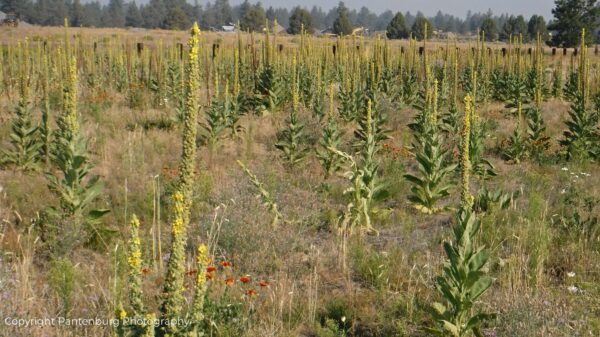
I was in line at a car wash, and happened to look over at a weedy vacant lot next to it. From my seat, I could see mullein. Intrigued, I parked my truck after it was clean and walked out into the area. There was also plantain there.
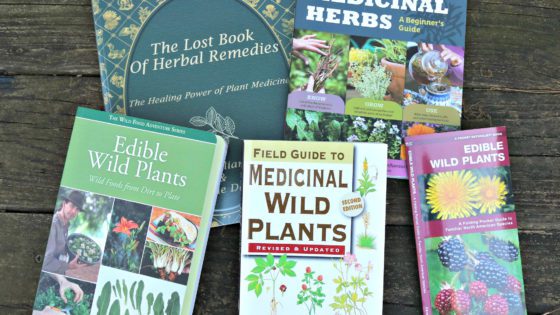
All these tied in with an article from Nicole Apelian’s The Lost Book of Herbal Remedies I had been reading that morning. In an urban setting, next to a busy highway, two of the three ingredients – mullein and plantain – needed for an emergency field dressing were found. I didn’t find yarrow among the wild plants (they are not weeds!), but there was a patch nearby in a flower bed.
I am a died-in-the wool Nicole Apelian fan. In addition to watching her two appearances on “Alone”, I also took a couple of Nicole’s classes at the 2019 Arkansas Flintlock Survival Gathering. Nicole is as personable as she is knowledgeable. Every survival library should have copies of her books The Lost Book of Herbal Remedies, The Forager’s Guide to Wild Foods and The Holistic Guide to Wellness: Herbal Protocols for Common Ailments.
Anyway, I’m always interested in natural solutions to modern medical problems. These plants could be really, really useful.
Historically three plants – yarrow, mullein and plantain – have been used for healing. Here is how you can combine the plants to make an emergency field dressing.
As always, don’t touch or pick any plant you can’t positively identify!
Yarrow (Achillea millefolium)
Yarrow is a flowering plant that has been used medicinally for more than 3,000 years. Its active ingredients have been studied for their antibiotic, antioxidant, and antiproliferative (agents that slow cell growth) properties. (Verywellhealth.com)
I have yarrow in my flower bed, and enough could be harvested along my street to supply a large group of folks. Yarrow is a versatile medicinal herb historically used to staunch bleeding, heal wounds, and reduce fever. It acts as an anti-inflammatory, digestive aid, and antispasmodic, commonly used for digestive issues, menstrual cramps, and skin infections. It is used as tea, tinctures, or topically.
I use a yarrow tincture in herb tea. It is easy to find yarrow in flower gardens. Look-alikes may be abundant in the summer and early fall landscape. Be careful! Three wildflowers – Queen Anne’s lace, yarrow and poison hemlock – look similar to yarrow, each with a white umbel blossom. While two of them can be eaten or used medicinally, water hemlock is extremely poisonous.
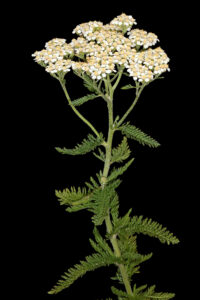
Yarrow has feathery leaves and a fuzzy stem.
Yarrow’s flowering stem is usually about 3-1/3-feet tall. Leaves are finely cut into linear segments giving them a feathery appearance and are hairless or have soft hairs.
If the plant has smooth stems with purple splotches, it may be water hemlock. DO NOT PICK OR EVEN TOUCH!
MAKE SURE YOU DIDN’T FIND POISONIOUS WATER HEMLOCK while looking for yarrow!
Check the video below to recognize it!
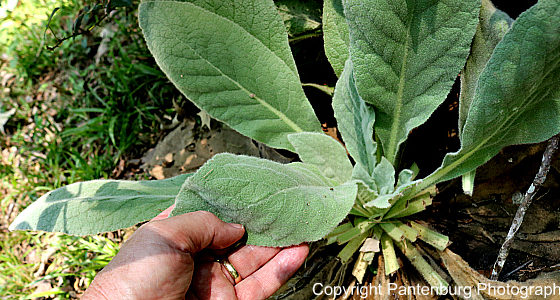
Mullein (Verbascum thapsus) is frequently classified as a noxious weed. Unless controlled, it can take over an area’s flora. The plants do very well in areas with poor soil that has been disturbed, such as construction projects.
Mullein is easily identified by its large, pale green, and heavily felted or fuzzy leaves that form a ground-hugging rosette in its first year. In the second year, it bolts a single, tall, unbranched stalk (up to 8 feet) covered in dense, soft, yellow-green, woolly hairs, culminating in a spike of five-petaled yellow flowers.
I use mullein every day as a tincture in my morning coffee or tea. By itself, mullein tea tastes like boiled weeds! I combine the mullein leaves with green tea and Celestial Seasonings Raspberry Zinger. This makes a tasty tea, that is really refreshing in hot weather. I learned this after mowing my lawn in the Mississippi summer heat – nothing tasted better at the end of the job.
The leaves are soft and fuzzy and can make excellent emergency toilet paper in the wild.
Plantain (Plantago major) Not to be confused with the banana-like plantain available in produce sections of supermarkets, broad leaf plantain grows well in poor soil that has been disturbed. (Think construction sites, road rights-of-way). Plantain is a species of flowering plant in the plantain family Plantaginaceae. The plant is native to Eurasia. The young, tender leaves can be eaten raw, and the older, stringier leaves can be boiled in stews and eaten. (Wikepedia)
One of my favorite plantain patches was along a little-used country lane. The plants were so prolific I could pick a weeks’ supply in a few minutes after church! The younger leaves were used in sandwiches, salads and as boiled greens. The “free” aspect greatly added to my enjoyment! (I really enjoy creating natural meals that doesn’t cost much at the grocery store!)
So how do all these plants work together?
The Roman legions used mullein for bandages, and that is how the plant would work in a field dressing. The big leaves would cover the wound or abrasion. Rich in compounds like flavonoids and saponins, mullein helps reduce swelling, potentially easing symptoms of arthritis and muscle pain. When applied topically, mullein’s emollient properties can soothe irritated skin, wounds, rashes, and conditions like eczema.
The nutrient-dense plantain plant has been used for centuries in traditional medicine to heal wounds, soothe skin, and treat digestive or respiratory issues. Known as a “green band-aid,” its leaves are rich in antioxidants (flavonoids), vitamins (A, C, K), and allantoin, supporting tissue regeneration and acting as a natural antimicrobial. (Healthline.com). A quick use is the chew or crush the leaves to make a paste or poultice, and apply it to the abrasion, insect bite or scrape. This can be covered with the mullein leaf.
Yarrow is a herbal styptic used for centuries to stop bleeding from minor wounds, scrapes, and nosebleeds. It works through astringent properties and the alkaloid achilleine, which constrict blood vessels and promote clotting. It can be applied as a fresh poultice, tea wash, or powder. (The Virtual Museum of Métis History and Culture )
In the case of a field dressing, yarrow’s best use might be to help stop bleeding from wounds, cuts or scrapes. The green leaves or fried yarrow could be applied to the injury.
Before considering this natural field dressing, make sure that nobody is allergic to any of the ingredients! And make sure the plants haven’t been sprayed with some herbicide or fertilizer!
In the event of some widespread emergency, no medical supplies may be available. In that case, these clean, washed plants may be a much better choice than a strip of cloth torn off a dirty shirt! Let’s hope you never need to use this natural field dressing!
Don’t touch or try to use any plant you can’t positively identify!
Please click here to check out and subscribe to the SurvivalCommonSense.com YouTube channel – thanks!
Leave a Reply