Cold Water Doesn’t Care How Good an Angler You Are
The angler who drowns in April is rarely a beginner. He’s usually experienced and alone, in waters he’s fished before, on a morning that looked fine from the truck. That’s the uncomfortable pattern. Competence as an angler doesn’t protect you from a 45°F river when the decisions that matter most were made before you left the house.
It only takes about five minutes to check the water temperature, wind, and environmental conditions the night before, and tools like Fishbox – all-in-one fishing app consolidate that critical information into one screen. But it’s the planning for your safety that matters more than what tools you plan with.
Here’s what cold water actually does, what it doesn’t do, and where the real margin lives.
What Cold Water Actually Does to You
Most people assume hypothermia is the killer. It usually isn’t. It’s what happens in the first sixty seconds after you hit the water.
Dr. Gordon Giesbrecht, the University of Manitoba researcher who has spent a career putting himself and volunteers into ice water, describes it as the 1-10-1 principle:
One minute to get your breathing under control. Sudden immersion triggers the cold shock response, which is an involuntary gasp followed by hyperventilation that can run several times normal breathing rate. If your head goes under during that gasp, you aspirate water. This is what kills most people, and it happens before hypothermia is even a factor.
Ten minutes of meaningful movement. Your hands and forearms lose dexterity and grip fast. You have roughly ten minutes of useful function to self-rescue – meaning get to shore, get onto ice, get a hand on something solid. After that your muscles stop cooperating even though you’re fully conscious.
One hour before hypothermia puts you unconscious. Longer than most people expect and it means a floating person wearing a PFD is often recoverable well past the point where bystanders assume it’s over.
Treat these as rough brackets, not a schedule. The National Center for Cold Water Safety points out that the numbers vary widely with water temperature, clothing, body type and whether you were braced for it.
Someone who falls in unexpectedly gets a worse cold shock response than someone who eases in deliberately. The framework is useful for understanding the sequence, not for calculating how long you’ve got.
The practical takeaway is narrow and specific: survive the first minute and you probably survive. The first minute! Everything in your kit and your planning should serve that.
Why Anglers Are Disproportionately at Risk
Boaters get safety messaging, they have life jackets, most recreate in warm weather, and they’re not always in the water. Anglers largely don’t get trained, and we’re exposed in ways that stack badly.
We fish the shoulder seasons. Early spring and late autumn produce some of the best fishing of the year, and they’re exactly when air temperature lies about water temperature. A 65°F afternoon in April can sit on top of a 42°F river. People typically dress for the air.
We fish alone. It’s half the appeal. It also means nobody is pulling you out. We stand in the water on purpose. Wading is normal to us in a way it isn’t for other outdoor pursuits.
We’re distracted at the worst moments. Nobody falls in while standing still. People fall in while landing a fish, changing position, or watching a rod tip instead of their feet.
None of that is an argument to stop. It’s an argument to plan the trip like your life matters.
The Wader Myth and the Thing That Actually Gets You
Ask around and you’ll be told chest waders fill with water and drag you to the bottom. It’s the most persistent piece of misinformation in fishing and it’s characterizing the wrong kind of danger.
Water inside your waders weighs the same as the water outside them. It has no meaningful downward pull. Testing this has been done repeatedly by people willing to jump into pools in full gear, and they float.
What waders genuinely do is far more dangerous in a river: they turn you into a sea anchor. Legs full of water create enormous drag in moving water. In moving water you’re not being pulled down, you’re being pulled downstream with the current like a log, into strainers, undercuts and rocks, while exhausting yourself trying to fight it. You can’t swim, can’t kick effectively, and the current gets a grip on you that it wouldn’t have on a swimmer.
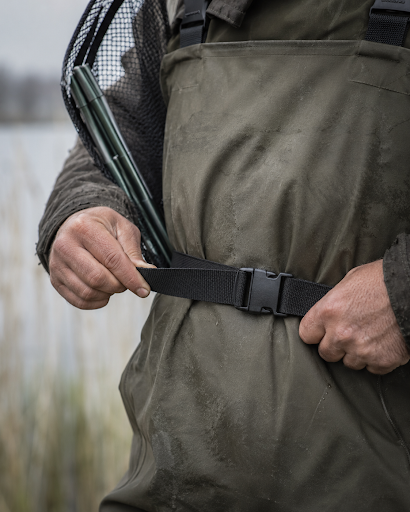
All of this is why a wading belt cinched tight at the waist is the cheapest piece of safety equipment you will ever own. It doesn’t seal you watertight, but it slows the fill dramatically and traps air in the upper body. That air is buoyancy, and buoyancy buys you the first minute.
Wear it every time. Not just when the water looks pushy.
What if your wader fill? If you do go under the surface in the current while wearing waders: get on your back, with your feet downstream and up near the surface, and backstroke at an angle toward the bank. Be like the rafters when their boat flips. Ride the current downstream with your feet out in front of you. Don’t try to stand until you’re out of the flow. Standing up in moving water is how feet get trapped.
The Five Minutes That Prevent the Emergency
Almost every cold-water incident traces back to a decision made on dry land. This is the part you control completely. Look up these conditions below and prepare for the worst.
Water temperature, not air temperature. This is the single number that matters and the one almost nobody checks. Below roughly 60°F, cold shock is in play. Below 50°F, treat it as genuinely dangerous. USGS river gauges and NOAA buoy data are public and free.
Flow rate and recent rainfall. A river that was ankle-deep last week can be pushing hard after two days of rain upstream. Gauge height and discharge tell you before you’re standing in it.
Wind, and when it’s forecast to change. Wind against current builds standing waves on open water fast. Small craft advisories exist for a reason.
Sunset time. Not “around six.” Most cold-water incidents involving lost or injured anglers happen because someone planned to fish “until dark” without knowing when dark was.
Tell one person where and when. Specific location, expected return time. This costs one text message and is the difference between a search and a rescue.
Doing all five means opening a weather site, a river gauge page, a tide table and a map. That friction is why most anglers skip it and consolidating those layers into one place is the honest argument for using an app for it. It’s not the software that makes you safer, it’s the five-minute climate check that actually gets done, while it’s easy to blow off a thirty-minute effort before you leave the house.
Where Your Phone Helps, and Where It Absolutely Won’t
Let’s be straight about this, because it’s oversold constantly.
Your phone is a planning tool. Before you leave the house with signal and full battery, it’s an excellent source to check conditions, water temperature, flow, tides, sunset, mapping, and telling someone where you’ll be.
Your phone is not a rescue tool. Batteries drop hard in the cold and can die at 30% indicated. Coverage on rivers and back country lakes is patchy to nonexistent. And in the first sixty seconds of immersion you will not be operating a touchscreen because your hands won’t work and you’ll be fighting to breathe.
Plan your trip with the phone. Don’t plan to survive with it.
Survival Gear For the Water Itself: PFD, wading belt, a whistle on your vest where you can reach it with a numb hand, and a fire kit in a dry bag if you’re anywhere remote. In cold country, a satellite messenger earns its cost the first time you need it.
Download your maps for offline use before you lose signal. That one habit has saved more people than any feature list.
The Uptake on Safety in Cold Water Angling
- Cold shock, not hypothermia, is what kills. You have about a minute to control your breathing and about ten to do something useful with your hands.
- Waders don’t sink you. They anchor you. Wear the belt.
- Check water temperature, not air temperature. Check flow. Know when the sun sets. Tell someone.
None of this makes you a worse angler or a more timid one. It means the trip that goes sideways ends with a cold walk back to the truck and a story, instead of the other thing.