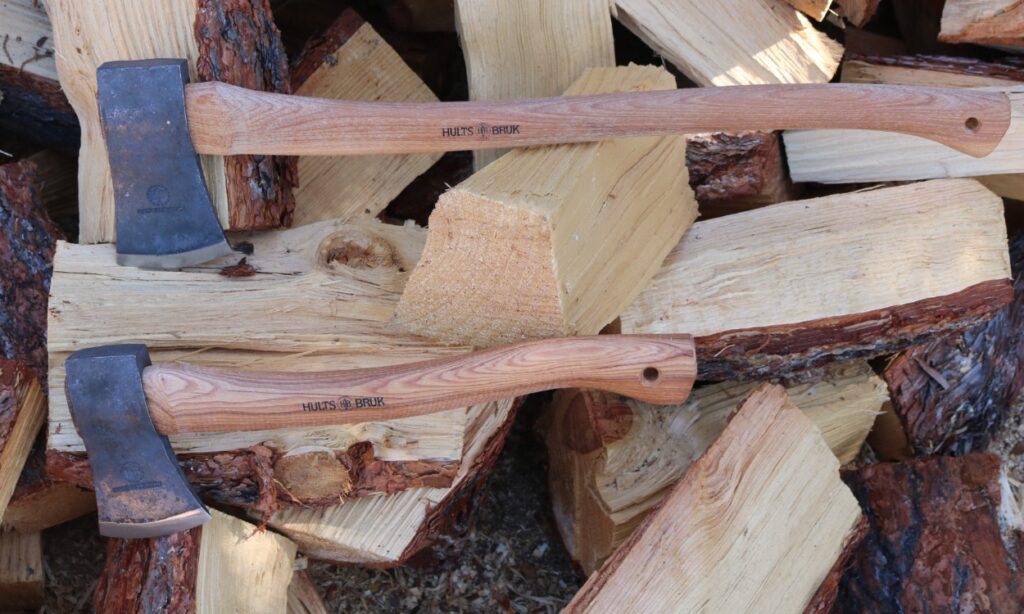
What is the best wood processing tool – axe or saw? There are good arguments for both. But if you’re opting for an axe, pick a good one. You may need a Hults Bruk.
By Leon Pantenburg
Disclaimer: Hults Bruk provided the axes for this review. I was not paid to publish it, and the company had no input or influence over its content. As always, this review reflects my honest assessment based on firsthand testing and experience.
The best endorsement of any product is who uses it, its overall value in a variety of situations, and its longevity. Hults Bruk axes have all this in spades. This September 2026, the company is introducing five new axe and hatchet models. According to Hults Bruk, they updated the cutting geometry on its historic Yankee pattern. The new collection features a higher grind for improved edge durability and cleaner release in wood.
What is a Traditional Yankee Pattern in Axe Heads?
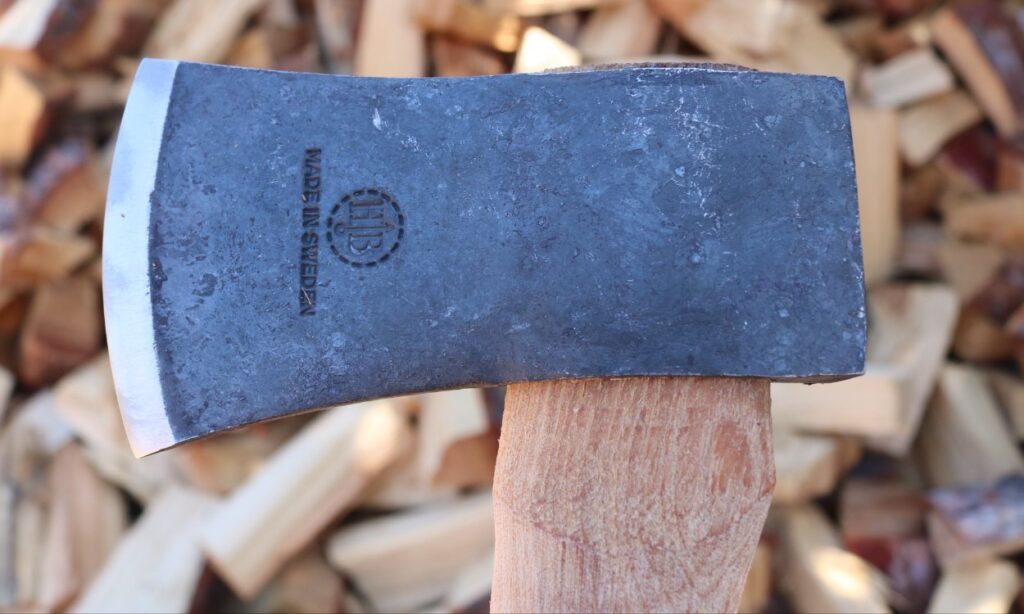
A Yankee pattern axe is a traditional American head design featuring a relatively flat, reinforced poll (hammer back) and a thinner, gently concave cheek profile designed for felling, limbing, and splitting kindling. Based on a 19th-century American design, the Yankee pattern has been produced continuously by Hults Bruk since the late 1800s and remains one of the company’s most popular axe profiles.
A word of caution: Don’t buy any axe or hatchet unless you have been trained in how to use it! An axe cuts with velocity, and a poorly aimed stroke could cause the tool to ricochet and cause serious injuries!
But How Do You Choose the Right-Sized Axe For You?
We’re going to rely on advice from a wilderness survival expert. The late Mors Kochanski was a legend in the outdoor survival world. For some 25+ years, he taught winter wilderness survival in Northern America and is the author of several bushcraft books.
Kochanski believed that an axe is more useful than a knife and is the most important survival tool in the north. Shelter and fire are the most important aspects of cold weather survival, he writes, and the ability to build a fire and shelter quickly could be the difference between life or death.
Doubling the axe weight does not equal twice the effectiveness of chopping, Kochanski claimed. In fact, the value of a large axe in wood smaller than 12″ is arguably nil and they are clumsy to limb with. Kochanski’s method for finding a good-sized axe for traveling with is to have one that fits under your extended arm.
Kochanski wrote that an axe with 2.5-pound head and with a 28-inch handle was capable of a lot of work but still portable and usable in one hand. The Rodga Forest Axe by Hults Bruk meets all these criteria.
It’s a while until winter here in Oregon, and wood cutting is not on the agenda for several weeks. I had to test the axes at the local church wood piles. The wood ranged from pine to hardwoods. Both axes performed really well.
Here are the Five New Axe Model Specs From Hults Bruk
Pjältån Hatchet — 1.3 lb. head, 15 in. handle, $129
A compact hatchet for kindling, carving, fire prep and everyday tasks around camp or the woodpile.
Sätra Hatchet — 1.3 lb. head, 17 in. handle, $139
A longer-handled camp hatchet that combines compact carry with added leverage and chopping power.
Getå Forest Axe — 2 lb. head, 20 in. handle, $149
A powerful two-handed axe for felling smaller trees, limbing and processing firewood.
Rodga Forest Axe — 2 lb. head, 26 in. handle, $159
A longer-handled forest axe built for steady chopping and limbing over longer sessions.
Bråbo Felling Axe — 2.6 lb. head, 25 in. handle, $169
The heaviest axe in the lineup, built for deeper chopping, stronger splits and heavier forest work.
Each axe is hand-forged from Hults Bruk’s proprietary Swedish steel with a forge-black finish, hand-sharpened then fitted with an American hickory handle and leather sheath.The collection spans the sizes from compact camp hatchets to larger axes for felling, limbing and firewood processing. The models are named for historic places near the forge, tying the collection to Sweden’s tradition of self-contained ironworking communities.
So How Do The Hults Bruk Axes Hold Up?
For several years, I lived in an antebellum house in Campbell Swamp, Mississippi that was heated almost entirely with wood. We cut firewood from the nearby deciduous forest. Most of the wood was white oak and we cut it with a chainsaw. Still, there was a lot of limbing and splitting that had to be done with an axe or wedge and mall.
I also built deer stands on the property, and used an axe and other cutting tools to clear shooting lanes, trails to the stands and for general brush clearing. An axe was frequently carried in the sled, because retrieving a dead deer might require creating a path through the brush to get to it. I developed preferences.
From my experience, the perfect camp axe has a 20-inch handle with a 1.75 to two-pound head. This is on the heavier side of a lot of great options. But it’s been the perfect combination for most of my uses. A small hatchet is also incredibly useful once you have the skill to use one.
Also, I want a hickory handle on any of my axes. The wood absorbs a lot of the impact from usage, and this is a big deal if you’ll be swinging the axe for extended periods of time.
My daughter Mary asked for a good hatchet for Christmas last year. She is a SCUBA diver, rock climber, backpacker, camper and outdoorsperson. She wanted a good hatchet for starting campfires in cold weather and she got a Hults Bruk Ågelsjön Hatchet.
Hults Bruk Review | Here’s What I Think
The axes came sharp! Both axes came shaving sharp (I typically test a knife and ax by shaving a part of my leg) and I could easily slice paper with either axe. The steel holds an edge well. Edge-holding is a valuable asset in any axe. They will stay sharp for a longer time, with fewer breaks for resharpening.
Balance: Swinging an axe for any length of time will make you appreciate a well-balanced tool. It takes less effort to use, and reduces energy expenditure. You want a balance point far enough forward to create power, but not so far forward that control is compromised.
Handle length: Longer handles generate more leverage and power, making them ideal for heavy chopping. Shorter handles offer better control and portability. The length on both of these axes are about right for their tasks.
Handle shape: An oblong handle shape makes it easier to grip and reduces hand fatigue. This in turn, makes it easier to place accurate strokes and increases efficiency. The curve at the end of the end helps assure the axe won’t slip out of your hand.
Leather sheath: All Hults Bruk axes come with sturdy leather sheaths that cover the cutting edges. This is really important for safety! That edge needs to be covered at all times the axe isn’t being used so it doesn’t become a hazard.
Flattened butt: The butt, or poll, is the flattened area opposite the bit (cutting edge). I am always using the poll as a hammer for such tasks as driving tent stakes into the ground or pounding a spacer into a chainsaw cut while felling a tree. The polls on these axes are designed so they work very well as hammers.
Head design: There are some Yankee design upgrades with these new Hults Bruk axes. Axe cheeks refer to the sides of the head that direct the blade as it bites into wood. Profiles with thicker cheeks are better for splitting, while narrower cheeks carve deeper initial cuts. The Yankee head appears to have narrow, tapered cheeks, which make it good for chopping. It bites deep with minimal force, but also would work well for splitting.
Order Hults Bruk axes here. The five new models will be available in September 2026 through select retailers and at us.hultsbruk.com.