I’ve always said when you head into the outdoors, you should pack a pencil and notebook with your ten essentials. You may have to leave a note where you’re going or write down GPS coordinates. In fact, I never leave the house without a pen and notebook for everyday use. When looking at the newest mechanical pencils, I’m now thinking through exactly what type of writing instrument I need with me all the time.
The mechanical pencil remains a surprisingly relevant tool for outdoor planning and fieldwork, even in this time where digital navigation and smartphone apps grow in usage for outdoor recreation. Unlike disposable wooden pencils that dull quickly or pens that freeze in cold weather, a quality mechanical pencil delivers consistent line weight and requires no sharpening. These are attributes that matter when you’re sketching terrain features, logging coordinates, or annotating waterproof maps miles from the trailhead.
Durability requirements for outdoor writing instruments differ substantially depending on the type of pencil or pen. Your choice of writing instruments for outdoor work require robust construction to handle exposure to moisture, temperature swings, and the stress of being jostled in a field pack. For lead based instruments, metal-bodied designs with knurled grips have become standard among serious users, while the lead advancement mechanism must function reliably even when contaminated with dust or grit.
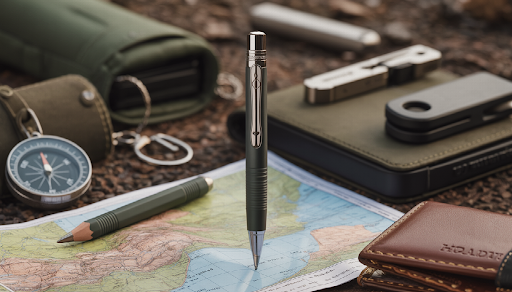
Engineering Matters in the Field When Using a Writing Instrument
Internal architecture of a mechanical pencil involves more precision than most users realize. The lead advancement system, whether clutch-based or ratchet-driven, must maintain consistent pressure while preventing lead breakage. Quality models use brass components rather than plastic gears, considerably extending operational life. The mechanical systems inside these tools reveal why price differences exist between budget and premium options.
Lead diameter selection affects both durability and precision. Common sizes include:
- 0.3mm: Ideal for detailed topographic work but fragile under pressure.
- 0.5mm: The most versatile diameter for general outdoor notation.
- 0.7mm: More durable for rough conditions, though less precise.
- 0.9mm: Rarely breaks but produces broader lines unsuitable for fine detail.
Lead hardness matters equally. HB grade offers a practical middle ground, while harder leads (2H, 3H) resist smudging on damp paper but require more writing pressure. Softer grades (B, 2B) work well in freezing temperatures when harder leads become brittle.
Mechanical Pencil Material Considerations and Longevity
There’s a real shift in the interest of quality, durable everyday carry tools and that’s elevated mechanical pencil design beyond simple functionality. Machined aluminum and stainless steel bodies withstand the kind of abuse that would destroy plastic alternatives.
Some pencil manufacturers now produce models specifically engineered for field use, with features like replaceable clips, sealed mechanisms to prevent debris intrusion, and grip sections that function with wet or gloved hands.
The Everyman Grafton mechanical pencil exemplifies this evolution toward purpose-built outdoor tools, incorporating a bolt-action mechanism that provides positive tactile feedback and reduces the likelihood of accidental lead advancement in a pack. Similar attention to practical details distinguishes field-ready instruments — like the Rotring 600 or the Pentel GraphGear 1000 — from conventional office supplies.
Environmental Argument for Using a Pencil Outdoors
There’s a real sustainability argument for mechanical pencils, centering on their refillable design, which eliminates the recurring material consumption of disposable alternatives. A single quality mechanical pencil can deliver the equivalent of dozens of wooden pencils over its service life. The manufacturing energy invested in a durable mechanical pencil is offset within the first year of typical use when compared to disposable options.
The calculation becomes more complex when considering lead refills and eraser replacements, but the core body – the component requiring the most manufacturing resources – remains functional for years or even decades with minimal maintenance. This longevity aligns with broader principles of sustainable gear selection that prioritize durability over disposability.
Including Mechanical Pencils into Field Kits
Weight-conscious backpackers and minimalist outdoor enthusiasts appreciate that a mechanical pencil eliminates the need to carry a separate sharpener. The writing instrument occupies minimal space while providing reliable performance across temperature ranges that would compromise many pens. Waterproof notebooks have become increasingly common among hikers and field researchers, and mechanical pencils pair naturally with synthetic paper that resists standard ink.
For those building comprehensive outdoor kits, the mechanical pencil serves multiple functions beyond simple notation. It can mark measurements on gear, create temporary trail markers on rocks or wood, and even function as an improvised stylus for capacitive touchscreens when fingers are too cold or wet for reliable operation. This versatility justifies its inclusion even in ultralight loadouts where every gram receives scrutiny.
The reliability of a well-designed writing instrument becomes apparent only when conventional options fail. Like when a wooden pencil point breaks for the third time while sketching a route correction, or when a ballpoint pen refuses to write on damp paper. In those moments, the mechanical pencil’s consistent performance transforms from a minor convenience into a genuine capability advantage.