by Leon Pantenburg
An emergency whistle should be part of your survival gear. Here is what you need to look for.
Flashback: The Titanic, 1997, Best Picture, Academy Awards.
The ship has gone down, and Kate Winslet is floating on a door in the freezing water. Leonardo DiCaprio has died of hypothermia and his body sinks to the depths. Kate is so cold she can’t even yell for help. But her whistle alerts a lifeboat and she is rescued. The whistle saves her life.
That’s the most dramatic illustration I can think of why you should include a whistle in your survival gear. But there are several practical reasons why it is a good idea to always have one close at hand.
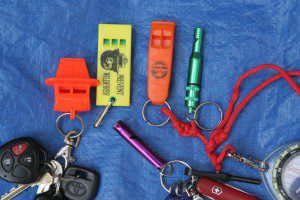
Whistles can communicate long distances or be life-saving tools that help search and rescue teams hone in on your location. If you need to attract rescuers, are lost in the wilderness, or trapped under rubble from an earthquake, a whistle may be lifesaver and worth its weight in platinum (or fill in your favorite precious, expensive material).
Just because you’re at work in an office building doesn’t mean the whistle shouldn’t be with you – emergency situations can happen anywhere, at any time.
Here is how a whistle, used properly, can help you escape a highrise.
So what does the best survival whistle need to have?
Look for:
Portability
If survival items are not compact, convenient and easy-to-carry they won’t be taken along. The most extensive, well-equipped survival kit is worthless if it is somewhere else when you need it.
Easily carried
IMHO, every whistle should have a lanyard or place to attach one. If the whistle gets dropped in mud, deep water or snow it could be lost forever. The lanyard makes it easy to wear the whistle as a necklace, or it could be tied to a zipper or belt.
No pea
This is the most important aspect of a winter survival whistle. The whistles – like coaches use – make noise by a rapidly spinning pea in a sound chamber. Most of the time they work just fine. But in freezing temperatures, the pea may freeze from the moisture in your breath and render the whistle mute.
Loud
It goes without saying that an effective survival whistle is loud.
At one of my survival classes, I had a student go across a ridge and down into a hollow and yell until we couldn’t hear him. Then we had him blow his whistle. The difference was dramatic – the whistle blower (pun intended) could be heard from a much greater distance.
Easy to blow
It shouldn’t a lot of effort make a sound. If a group is trapped and needs help, the whistle could be passed around and everyone could use it. The continual noise may be what search-and-rescue needs to find you.
Visible
Get a bright-colored whistle so you can find it easily if it’s dropped. It is also a good idea to have a brightly-colored lanyard attached to it.
I came across this excellent article from trueprepper.com about picking the best whistle. Here is what to look for.